Marine Scanning in the
Maritimes
Last updated March 16, 2010
© 2010, MARITIMES SCANNING SITE, all rights reserved
Link to the Canadian Coast Guard's book Radio Aids to Marine Navigation. Lists CG radio stations and VTS stations, along with frequencies and scheduled broadcasts, and maps.
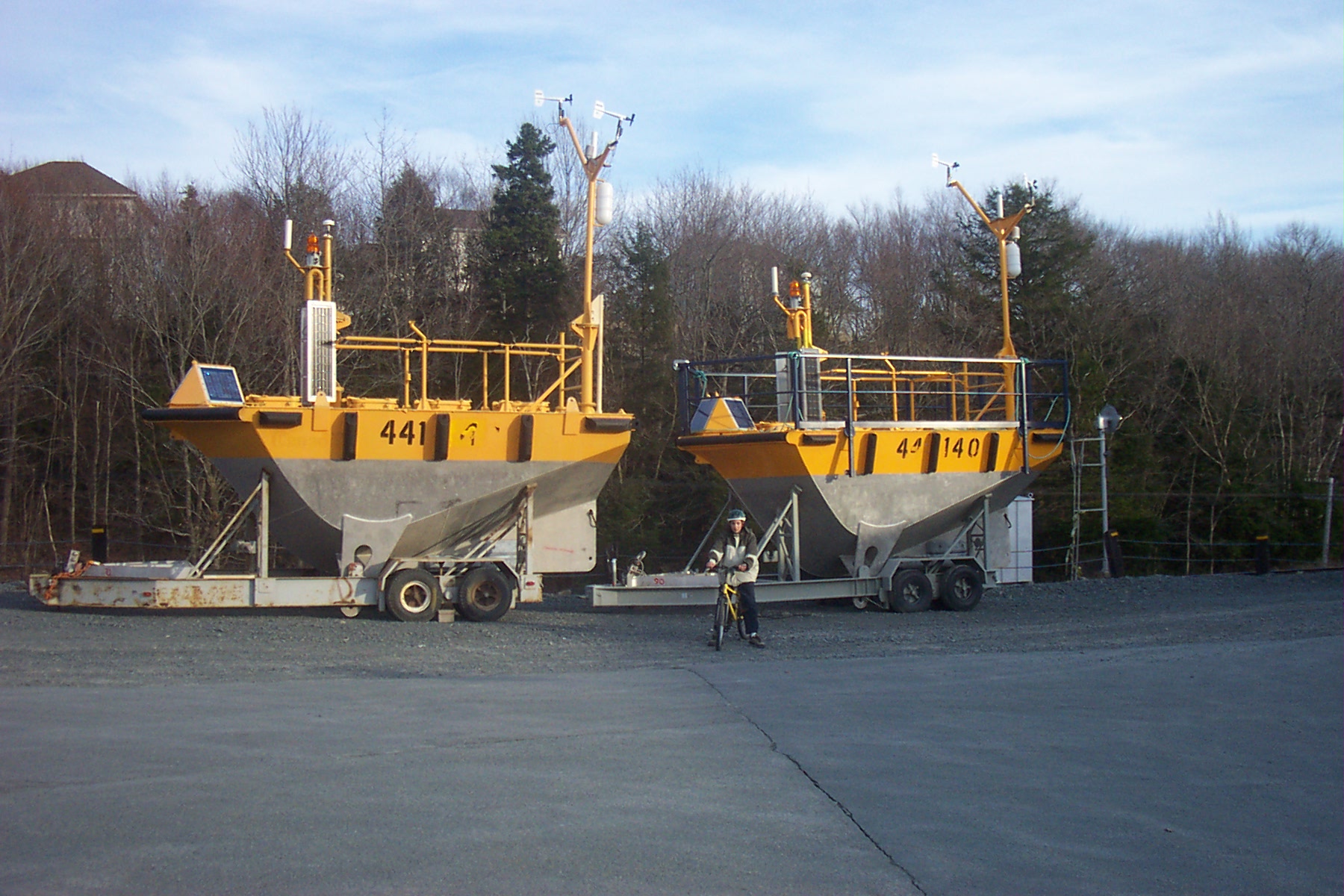
Photo of weather buoys that are deployed offshore.
Marine monitoring takes two major forms. One involves the reception of High Frequency (HF) radio using a communications receiver on frequencies from 2 to 17 MHz. At one time the HF band would have been very busy, with much local and regional traffic on the lower end, and longer distance traffic on the higher end. Today there is very little, with the local almost extinct. Suffice to say that local traffic has long since gone to the VHF and UHF bands and the realm of scanning, which is the aspect I am concentrating on in this page. VHF and UHF marine scanning is concentrated in the VHF Marine Band, with some private "company" traffic also found on other frequencies.
VHF Marine Band
This is an international band used around the world and ships of all nations are equipped with similar equipment. Channels are numbered from 01 to 28 and from 60 to 88. There are no channels numbered in the range 29 to 59. The band extends in various sections from 156 MHz to 162 MHz and contains a standard set of internationally recognized channels; however not all nations use all of these, or use them in the same ways. Canada and the USA deviate significantly from international usage, and in turn these two countries are different in usage from each other. This band is for public use, to the extent that although some channels are set aside for various purposes, they are not generally given over for the exclusive use of any one company or user. Moreover, anyone with any VHF marine radio can listen to any of these channels. This public aspect can become somewhat hazy, as for example, in the Halifax area, Channel 7 is used by the major tugboat company for its operations, but does this mean that someone else who happens to use it is a trespasser?
Scrambling is allowed on at least some of the marine channels but not where safety of life and navigation are concerned. For example two fishing vessels communicating re fishing success could use scrambling.
Canada uses practically all of the international channels at least somewhere in this country but does not necessarily use both frequencies of all two-frequency channels.
Most of the 88 channels are made up of two frequencies: a base (coast) transmit frequency and a mobile (ship) transmit frequency (2-frequency duplex) that are always 4.6 MHz apart. For example Channel 03 is made up of 156.15 and 160.75 MHz frequencies.
The frequency range of the Marine Band is discontinuous:
156.025 to 157.425 MHz in 25 kHz steps. Mobile (A) side of duplex channels, plus simplex channels.
160.625 to 160.95 and 161.5 to 162.025 MHz in 25 kHz steps. Coast side (B) of duplex channels.
The frequencies between 160.95 and 161.5 are not part of the Marine Band. In North America they are part of the Railway band.
Now for more on that apparently strange situation that there are no Channels 29 to 59. What happened to them?! Well, in a nutshell there never were any 29 to 59. What happened is that there were originally only Channels 01 to 28, spaced at 50 kHz intervals. With higher demand and an improvement in technology, a additional set of channels was placed in between the original ones, so that the spacing became 25 kHz. I am not sure why the second set was numbered from 60 to 88, rather than just continuing the existing sequence but there you have it. Invariably a channel numbered in the 60 to 88 range is 60 numbers higher than the channel just below it in frequency. For example Channel 66, which is 156.325 MHz is one up from Channel 06, which is 156.3 MHz.
Here is a part of the frequency/channel chart to show you what I mean:
| Channel 6 | 156.3 |
| Channel 66 | 156.325 |
| Channel 7 | 156.35 |
| Channel 67 | 156.375 |
This of course means that the channel number progression does not correspond with the frequency progression. For example if the channels are arranged in frequency order, Channel 62 lies between Channel 02 and Channel 03.
It should be noted that while in theory there are channels 1 to 28 and 60 to 88, there are two channels never used, and in fact may be blocked from marine radios. These are 75 and 76 which are the adjacent channels in frequency to Channel 16, which is the international calling and emergency channel.
Perhaps the major difference amongst nations is that some had already assigned some of the marine band frequencies to other services and therefore do not allow use of some marine channels, or restrict their use severely. For example here in North America the land mobile band in the 155 MHz band and familiar to scanner users actually extends to 156.24 MHz. This means that in most of this continent's waters, the first marine channel in use is at 156.275, but there are some exceptions where the authorities have not allowed any land mobiles on clashing frequencies in a particular area. The bigger problem in North America is a clash on the high end with the Railway Band. Suffice it to say that its existence has meant that quite a number of the international duplex marine channels cannot be used in North America because the high side is already being used, in theory at least, by the railways. The Americans and to some extent Canadians have avoided totally abandoning the affected marine channels by dividing some of the 2-frequency channels and using only the low side, as simplex channels. For example, Channel 22 is internationally a two frequency (duplex) channel made up of 161.7 MHz (coast stn) and 157.1 MHz (ship station). The high part (161.7) is not used but the low side (157.1) is used extensively as a two-way simplex channel and designated Channel 22A or Channel 22 US Mode. Marine radios are built to accommodate these two different ways of using the duplex channels. There are also cases in which only the high side is used. Canada, for example, uses the base side of Channel 21 (161.65 MHz) for broadcasts and only uses the mobile side (157.05 MHz) on the Pacific coast, and only as a simplex frequency. This channel in Canada is therefore divided into two, referred to as Channel 21B and Channel 21A respectively. The "A" and "B" refer to the low and high components (sides) of the two frequency channels.
As an added complication, there are two B side frequencies that Canada does use as simplex channels (87B and 88B) which are only used for automatic ship identification systems. The A side of these channels are used independently for other uses.
Narrowbanding of the VHF Marine Band: The discussion above did mention a narrowbanding that occurred many years ago, when channels 60 to 88 were added between channels 1 to 28. Now with the progress of technology a new round of narrowbanding is in progress, albeit very slowly. At present the standard usage of the band is with 25 kHz spacing; however it is thought that 12.5 kHz spacing is authorized but not implemented. This would see a doubling of the number of channels available. Numbering would follow a convention of adding a "2" in front of the number of the next lowest channel. For example 156.40 is Channel 08 and 156.425 is Channel 68. The new 12.5 spaced channel lying between, on 156.4125, would be labeled as Channel 208. There are also proposals to go one level further than this, to 6.25 spacing but this is not thought to yet have any international authorization. Here is a chart showing a section of the channel plan showing the original 50 kHz channel 01 and the more recent Channel 60 as well as planned and proposed 12.5 and 6.25 kHz channels:
| Channel Numbers | SHIP | COAST | |||||
| 60 | Current 25 kHz channel (Series 60 - 88) | 156.025 | 160.625 | ||||
| 160 | Proposed 6.25 kHz channel | 156.03125 | 160.63125 | ||||
| 260 | Authorized 12.5 kHz channel (not yet in use) | 156.0375 | 160.6375 | ||||
| 360 | Proposed 6.25 kHz channel | 156.04375 | 160.64375 | ||||
| 01 | Original (and current) 50 kHz channel (Series 1 - 28) | 156.050 | 160.650 | ||||
| 101 | Proposed 6.25 kHz channel | 156.05625 | 160.65625 | ||||
| 201 | Authorized 12.5 kHz channel (not yet in use) | 156.0625 | 160.6625 | ||||
| 301 | Proposed 6.25 kHz channel | 156.06875 | 160.66875 | ||||
| 61 | Current 25 kHz channel (Series 60 - 88) | 156.075 | 160.675 | ||||
The preceding narrowbanding chart was modified from one available at http://www.navcen.uscg.gov/MARCOMMS/vhfnb.htm
The use of the VHF marine band in the Maritimes
This can be conveniently divided into four different but overlapping categories. Frequencies are shown where practical. More detailed usage charts will follow.
1. Canadian Coast Guard Radio Stations. The top priority of these stations is mariner and vessel safety and this principally involves two-way traffic involving safety (including emergencies) as well as broadcasts of notices to mariners and weather and ice conditions. In this region they also provide the only dedicated marine telephone service, this being the service in which telephone calls can be made through a vessel's marine radio. [There is NO commercial counterpart to this in Atlantic Canada, unlike the Pacific Coast where both the Telephone Company and the Coast Guard provide service]. At present there are radio stations at Sydney, Halifax and Saint John. The stations at Yarmouth and at Charlottetown were consolidated into the Saint John and Sydney stations a few years ago. The three stations have many remote transmitter/receiver sites so that it is realistic to say that the location name refers only to where the operating personnel are sitting. These stations have access to many marine channels but their working channels are 16 (calling), 24, 26 and 27. An interesting point about this is that other than Channel 16, the calling channel, and Channel 19, mostly used to communicate with Coast Guard ships (but sometimes others as well), the working channels are mostly duplex, meaning that the coast station and the vessel are on two different frequencies. This is a nuisance for us scanner listeners! In much of the world duplex channels are only used for phone calls (patches) but things are a little different here. On the west coast of Canada the Coast Guard stations use simplex Channel 22A for routine communications with vessels, much like the US Coast Guard.
The CG Radio Stations provide continuous marine broadcasts on 21B and 83B throughout the region. These are channels used by ships in Canadian waters only for listening, and never to transmit. (Please note that the 25B is also available but not used in this region)
2. Canadian Coast Guard Vessel Traffic Management Stations. These are stations somewhat like air traffic control stations, except that they do not exert the same level of control over ships and their masters as the air control stations do over aircraft. The VTS stations are established to aid in arranging the orderly movement of vessels in congested areas and rely heavily on radar coverage and series of calling-in points at which ships report their position and time to the next point. At present the areas covered by VTS are:
| Area | Voice Call Sign | Channels | Link |
| Halifax Harbour | Halifax Traffic | 12 & 14 | MAP |
| Bay of Fundy and Saint John Harbour | Fundy Traffic | 12, 14 & 71 | MAP |
| Strait of Canso/Chedabucto Bay | Canso Traffic | 14 | MAP poor quality |
| Confederation Bridge | Northumberland Traffic | 12 | MAP |
Please note that there are special purpose control stations at the Canso Causeway canal (Channel 11), and the St. Peters Canal (channel unknown, possibly uses 16 only, or possibly Channel 10)
The above two categories of Coast Guard stations are in reality consolidated, i.e. the radio station function and the VTS function are co-located and in fact the same personnel can be assigned to either function. These consolidated stations are called MCTS Centres (Marine Communications and Traffic Services Centres) and are located at Sydney, Halifax and Saint John.
3. Private Users. Various commercial firms, particularly fishing companies (including vessels and shore facilities) and others such as towboat, salvage and mineral resource companies use the VHF marine band for intership and ship to shore communications. This is also true for recreational users including private vessels as well as marina operations.
4. Government Users. Provincial and federal government departments use the VHF marine band for intership and ship-to-shore use. The principal government users are the Department of Fisheries and Oceans, of which the Canadian Coast Guard is a major component, and also the Department of National Defence (the Canadian Navy). The navy rarely uses VHF amongst its own units at sea as it also has other preferred bands and means at its disposal. It does use VHF within Halifax Harbour (Channel 10, 156.5 MHz, for its own dockyard and support activities) and of course uses the Marine Band to communicate with civilian vessels and the Coast Guard stations. The Department of Fisheries and Oceans also uses VHF to communicate with "civilian" vessels (in quotation marks because DFO itself is civilian, not military). In addition the Coast Guard does use VHF marine for some of its departmental communications, using Channel 19, 156.95 MHz. You might hear Coast Guard vessels working the shore bases such as the major one in Halifax, and also working the Coast Guard Radio Stations on Channel 19. This channel is sometimes also used to communicate with civilian stations. The government category also includes pilotage services and various in-shore police and public safety agencies.
VHF MARINE BAND USAGE IN THE MARITIMES
Following is a detailed list mostly from here in the Halifax area. Please e-mail me at marscan1@canada.com with any additional info from throughout the Maritimes. Where particular local users are listed I am not sure that they have any exclusive rights in a legal sense. Please note that any vessel has the technical possibility of using any channel (except that they cannot transmit on the B side of duplex channel - only special marine radios for coast stations can do so), and therefore to some extent there is an honour system that they will not use ones they are not authorized for. The practical result is that conversations can be heard from time to time on unexpected channels, which of course has interference implications for legitimate marine users, or in some cases user of the frequencies (or nearby ones) that are not even in the marine service in our region.
A second point is that the Canadian Coast Guard and other federal users such as Fisheries Protection can and will use channels assigned to fisheries and to recreational uses, in order to contact those users if the normal calling channels do not produce results.
| Marine Channel | Frequency* | Use in this area | Notes |
| 00 not an actual marine channel | 156.0 | CCG technical services | This is a land mobile frequency |
| 04A | 156.2 | Commercial Fishery | several licencees |
| 06 | 156.3 | Intership/Docking | |
| 07A | 156.35 | Hfx tugboats Pugwash pilots |
Eastern Canada
Towing Atlantic Pilotage Auth. |
| 08 | 156.4 | Hfx Navy miscl | hrd with Reserves and with personnel landings |
| 09 | 156.45 | poss CCG/Navy | not hrd |
| 10 | 156.5 | Hfx Navy QHM licenced elsewhere for civilian port ops |
Naval ship control in Hfx |
| 11 | 156.55 | Hfx: CCG/Pilots?? Pilots Sydney? Canso Canal Operations |
|
| 12 | 156.6 | Hfx Traffic inner, Fundy Traffic inner, Northumberland Traffic entire | |
| 13 | 156.65 | bridge to bridge | not often hrd this area. CCG listed as licencee |
| 14 | 156.7 | Hfx Traffic outer, Fundy Traffic outer, Canso Traffic entire | |
| 16 | 156.8 | Calling and Distress | |
| 17A | 156.85 | Hfx and Pugwash Pilots | Atlantic Pilotage Auth |
| 18A | 156.9 | Encana Corp, Halifax | |
| 19A | 156.95 | CCG Operations | usually CCG units only |
| 21B | 161.65 | CCG Broadcasts | continuous broadcasts |
| 22A | 157.1 | USCG Maine | Several locations in the Maritimes |
| 23 | 161.75/157.15 | Hfx Pilots dispatch | |
| 24 | 161.8/157.2 | CCG Working and Phone Patch | |
| 25B | 161.85 | CCG Broadcasts | continuous broadcasts (not used in Maritimes) |
| 26 | 161.9/157.3 | CCG Working and Phone Patch | |
| 27 | 161.95/157.35 | CCG Working and Phone Patch | |
| 61A | 156.075 | Commercial Fishery | |
| 62A | 156.125 | Commercial Fishery | |
| 65A | 156.275 | Hfx Port Authority | unsure if duplex or A |
| 66A | 156.325 | Hfx Inshore Rescue | not listed in TAFL |
| 67 | 156.375 | Commercial Fishery | many users |
| 68 | 156.425 | Recreational | several yacht clubs |
| 69 | 156.475 | Commercial Fishery | many users |
| 70 | 156.525 | CCG | digital selective calling |
| 71 | 156.575 | Fundy Traffic upper bay, also Recreational in some areas. | |
| 73 | 156.675 | Commercial Fishery | many many many users |
| 74 | 156.725 | CCG ops | listed for several lighthouse locations |
| 77A | 156.875 | Pugwash pilots and also in use at Saint John for docking LNG ships | Atlantic Pilotage Auth. |
| 79A | 156.975 | Survival Systems Training Ltd | THOUGHT TO BE SIMPLEX BUT UNSURE |
| 80A | 157.025 | Hfx Navy Fleet Diving Unit?/ CCG Ops | |
| 81A | 157.075 | CCG | not hrd |
| 83B | 161.775 | CCG Broadcasts | several locations in Maritimes |
* Where two frequencies are shown, the first is the coast station transmit frequency, and usually the better of the two to monitor. The second frequency is the mobile (ship) transmitter frequency. In some cases the coast station will retransmit the mobile side on its frequency.
Here is an interesting site outlining some of the uses of marine
VHF in Canada:
Pat's Boating in
Canada.. This site concentrates on recreational use but does hint at the
differences amongst various parts of Canada.
RADIO USE BY MAJOR MARINE INTERESTS IN THE MARITIMES:
All of these users also use the regular VHF marine band as they must be able to communicate with other vessels, and with Coast Guard shore stations.
Canadian Navy: The navy makes extensive use of short-range UHF communications for ship to ship traffic and also still uses light signals, as they are less susceptible to interception by others. Long range communications are still to some extent via HF radio and more so now by satellite communications through dedicated Military satellites.
Other Federal Government users: Principally this means the Department of Fisheries and Oceans, including the Canadian Coast Guard. These vessels do have HF radio for long range communications. I am not privy to the frequencies involved. It must be expected that they too have satellite phones using commercial services. The Coast Guard ships do have several of the VHF marine channels set aside for their use, but again, keep in mind that any other ship can monitor these. The Fisheries enforcement component of DFO has a "private" VHF system in the Maritimes in the 160 MHz range operating in the Gulf of St. Lawrence area and including inland areas of central and northeast New Brunswick. The Atlantic coast area, including the Bay of Fundy and all or most of Nova Scotia is a user of the Nova Scotia Trunked Mobile Radio system, and uses encrypted communications exclusively except in liaison with other agencies.
Marine Atlantic: Marine Atlantic is the modern manifestation of Canadian National Railways ferry system. As such it is interesting to note that the VHF frequencies they use today are from the North American railway band. The following are the licenced frequencies and transmitter locations.
| Frequency | Location or Use |
| 160.2 | North Sydney, Port Aux Basques |
| 160.47 | North Sydney |
| 160.725 | North Sydney. Cape North, Port Aux Basques |
| 160.905 | North Sydney. Cape North, Port Aux Basques, Argentia |
| 162.345/163.26 | On-Ship repeaters |
| 457.525 | On-Ship simplex |
| 453.2375 | On-Ship simplex |
Please note that 160.725 and 160.905 are also used by Bay Ferries in the Bay of Fundy. Possibly this indicates that in the old railway era, that these were set aside as railway ferry frequencies generally.
Marine Atlantic also has a number of longer range HF frequencies for use by vessels out of VHF range. These upper sideband frequencies for which you will need a communications receiver:
2324.5 kHz
2367.5 kHz
4466.5 kHz
4993.5 kHz
5761.5 kHz
7409.5 kHz
7836.5 kHz
11418.5 kHz
For those of you wondering why these all end in the decimal 5, it is more or less this: When HF communications were full AM (double sideband) emissions most assigned frequencies were full whole numbers. For example, 2366 kHz was a major Canadian intership frequency. When SSB (single sideband) came in, in this case the Upper Sideband variety, the listed frequencies became the centre of the sideband which is 1.5 kHz higher than the centre of the old full double sideband signal. 2366 became 2367.5, and so on.
Bay Ferries: Bay Ferries is really divided into three separate services, each with its own radio system or methods.
1) Northumberland Ferries. These vessels operate in the ice-free months between Caribou, Nova Scotia and Borden, PEI. In good weather the vessels are in sight of shore at all times, and therefore VHF and/or 800 MHz are sufficient. For communication between the terminals and the ships and for in-terminal operations, the company operates a 800 MHz system. It is not known if this is trunked or conventional. The three licenced frequencies are 851.0125, 851.2625, and 851.5125 MHz. with transmitters at both terminal locations. You may be interested to know that 851.0125 is the very lowest frequency available in the Canadian 800 MHz band and is called Channel 001 by Industry Canada. The other two frequencies used by Northumberland Ferries are Channel 11 and Channel 21. It is normal for one licencee with multiple frequencies at one site to have them allocated in 10-channel intervals, i.e. 0.25 MHz intervals. This is also the rule of thumb at all the NS Trunk sites...
2) Bay of Fundy Service. This vessel is the descendent of the old Canadian Pacific Railway/Dominion Atlantic Railway ferry service that used to connect the CPR in New Brunswick with its outlying service in Nova Scotia. This service has two railway band frequencies, 160.725 MHz and 160.905 MHz, with repeaters in Digby and in Saint John.
3) Yarmouth to Maine services. Currently this operates with the CAT high speed ferry between Yarmouth and on an alternating basis Bar Harbour, Maine, and Portland, Maine. Due to the length of these routes it is to be expected that they would have their own HF frequencies or other long range means. A search of TAFL has revealed nothing for this company, so for now this one remains a mystery. As of 2010 this service has been discontinued.
Coastal Transport: Blacks
Harbour to Grand Manan, NB. This service also uses 160.725 and
160.905 MHz from the railway band. I have no idea why they are
authorized to use these frequencies, unless they too are a descendent of the old
railway company ferries.
CTMA Traversier Ltee: Souris PEI to Magdalen Islands,
Quebec. I can only find HF frequencies for them, 4147.4 and
5271.4 kHz USB.
Halifax Harbour ferries: the NS Trunk (800 MHz), as part of the HRM transit system. Also heard frequently on 156.6 MHz channel 12.
NS provincial ferries, which are all short range, use the NS trunk, as part of the provincial highways department.
NB provincial ferries: use the provincial radio system (VHF and/or UHF). More information is required.
UHF Marine
In Canada there is an allocation of UHF frequencies in the 450/460 MHz range for shipboard use. In other words these are for administering and coordinating shipboard activities. It is unknown if these exact allocations are also used by other nations. It is known that some of them do conflict with American GMRS repeater inputs, and therefore if a Canadian vessel was to use them in an American port, there could be conflicts. Similarly, foreign ships may have allocations from their home governments that conflict with Canadian usage. Check this page for more iinformation.