of the many types and varieties of BC plates, go to https://www.bcpl8s.ca/ presented by Chris Gerrish.
I highly recommnend that you visit there as it is a wonderful storehouse of knowledge.
|
Provincial plates were introduced with a porcelain plate
in 1913 and another in 1914. These were followed
by three years of thin flat metal plates, and then by a
series of embossed plates, with renewal tabs for some
years. My collection begins in 1924 when a new style was introduced showing the provincial name in full. This series ended in 1951 and included both long and short plates to suit the number of digits, depending on the particular year, with some years having both. Up to and including 1930, production was commercial, by tender. From 1924 to 1929 the tender was consistenly won by the Tacey Company from Vancouver, a fact that was generally a cause for questions, and leads to this era being called the "patronage era". For in-depth information regarding Tacey and a wealth of other BC plate information see the bcpl8s site. I am actively collecting BC passenger plates from 1924 onwards to the beginning of the flag design in 1985. |
 |
|
 |
1926 needed |
 |
1928 needed |
 Last Tacey-manufactured plates. This is a rough example, but fills the space. Looking to upgrade! |
|
|
With a change of government in British Columbia, the Tacey company narrowly lost in the bidding process for the 1930 plates, being narrowly undercut by another company. Although this plate appears to be similar to the previous Tacey block style, it is different. Note the zeroes in particular. According to www.bcpl8s.ca it is unknown where these were manufactured, possibly not within BC.even thiough they were produced by a BC company. |
 |
|
In 1930 the provincial government ended the production of plates by commercial companies and instead began their production in the Oakalla prison located in the Vancouver suburbs. Equipment formerly used by the Tacey company (including dies) was purchased for use at Oakalla, with the first run being for 1931. Plates for 1931, 1932 and 1935 came in two sizes: 6 by 13 1/2 inches to accommodate up to 5 digits, and a longer version (not shown) to accommodate 6 digits. The dies were the curved Tacey variety in 1931 and 1932, and block style in 1933 to 1935. |
 |
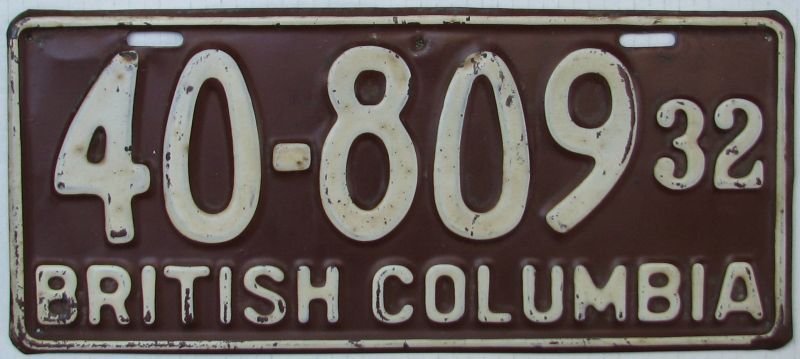 |
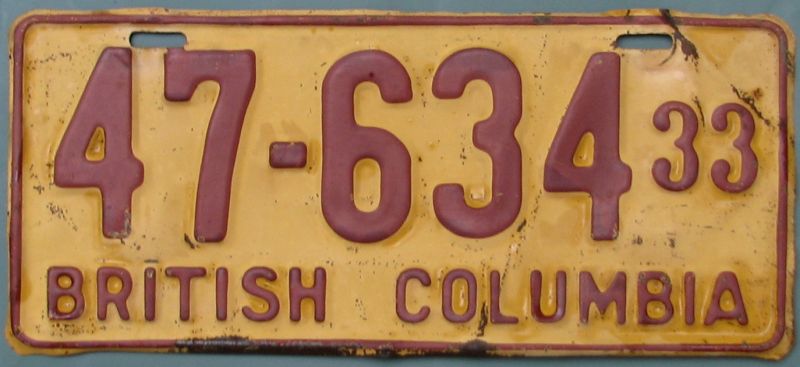 |
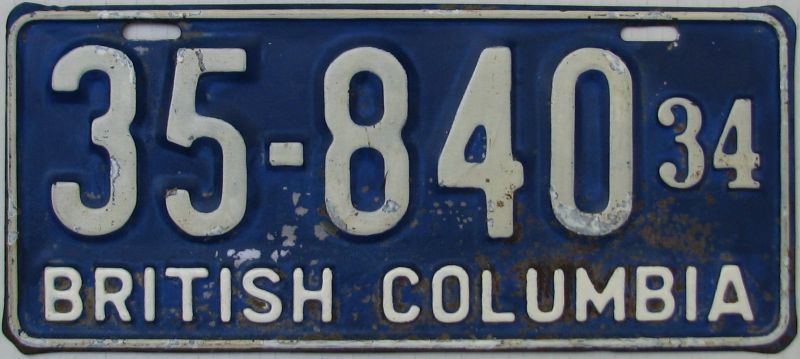 Some retouching on the white but still a nice example |
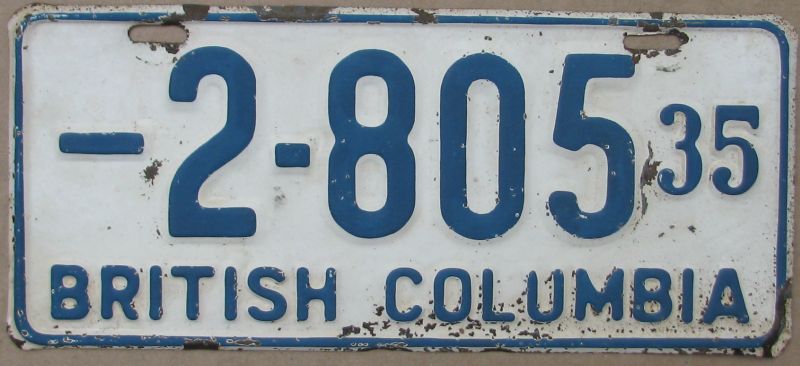 |
|
The Oakalla Short Years 1936 to 1951 From 1936 to 1951 passenger plates were standardized at 5 1/2 by 11 1/4 inches. therefore significantly shorter than the preceding series, and 1/2" less in height. This was most likely a cost-cutting change, and was enabled by the introduction of C prefix commercial plates. This eliminated the requirement for six digit plates and therefore with five digits as a maximum, and with other design reductions, the plates could be shorter. The font became uniformly the Tacey curved (slanted) type, used uniformly though to 1954 for passenger plates and a little longer for at least some non-passenger types. Note: In 1949 to 51 plates were produced in a longer length variety to accommodate six digits. Office of issuance is shown if known, based on records linked at the bcpl8s site. Note that plates with one to three digits were issued to applicants directly from Victoria, and were ongoing, i.e registrants could have the same number each year. Plates with four digits and the lowest end of the five digits were normal issues in the Victoria area. |
|
|
|
 Vancouver issue |
 |
 |
 Nanaimo issue. Beginning in 1940, passenger plate issues exceeded 99,999 and therefore a prefix letter was used with up to four digits for issues beyond 99,999,. The prefix letters used varied from year to year and were tied to specific regions of the province. This situation continued to 1948. |
 Vernon issue |
|
1942 to 1947 Single Issues Due to wartime steel shortages or priorities the authoriites in BC issued only one plate, to be mounted on the rear. Two plates were produced in 1942 but one of each pair was retained and restamped witth a 3 instead of the 2, for use in 1943, and were repainted. For 1944 to 1947 only one plate was produced. |
|
 Greenwood issue |
 Chilliwack issued |
 Vancouver issue |
 Victoria issue |
 Nanaimo issue |
 Vancouver issue |
 Despite having a U prefix this is a passenger plate. |
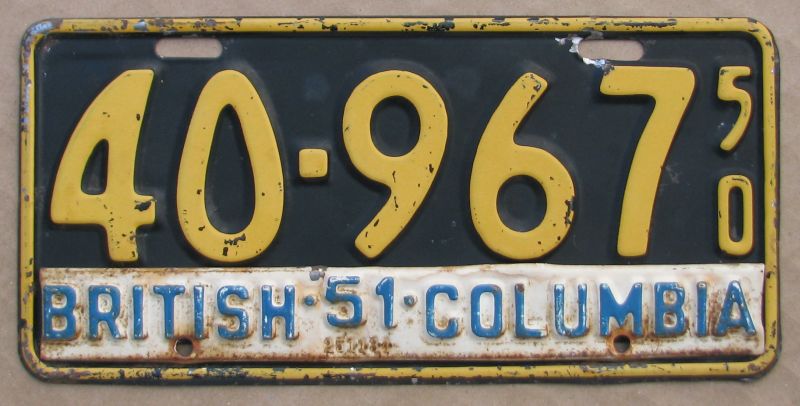
 Victoria issue. For the 1949 and 1950 passenger plate issues beyond the five digit limit, longer plates with six digits were issued. Prefix letters were not used for passenger plates in these two years. |
 Nanaimo issue |
 |
|
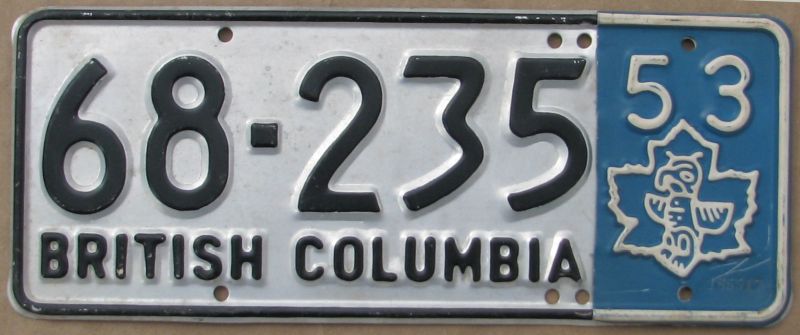
The Oakalla 1952 Passenger Base For 1952 British Columbia produced longer plates, contrary to the wider trend in North America. In this era there were a number of jurisdictions that produced aluminum plates, and opted for annual tabs to indicate revalidations and later issues. Note that in this three year period, passenger plates were not "all-numerical" and various letters were also added at the end of 4 digits, depending on the office of issue. Low numbers of 1 to 4 digits continued to be issued. Note that non-passenger plates with more than five characters in the serial had a smaller year and totem, and correspondingly smaller tabs in 1953 and 1954 Note that base plates, normally seen with 52 over the totem, were supplemented by later issues with a blank at the right, as that section was covered by a tab. Note that non-passenger plates were individual annual issues during this period using the same colours as used on the passenger tabs. |
|
|
|
|
|
|
|
 Nanaimo issue |
|
|
The Oakalla Later Annual Issues 1955 to 1977 FOR 1955, BRITISH COLUMBIA BEGAN PRODUCING 6 x 12 PLATES TO FIT THE NORTH AMERICAN STANDARD. Passenger plates were
numerical only, ranging from single digits (by
reservation and special request) through to six digits.
|
|
 |
 |
 |
|
|
Unofficial booster plate widely distributed throughout the province
|
|
 |
 |
 |
|
 |
 |
 |
 |
 |
 |
 |
 |

As is detailed in my family
historical page, my father began obtaining the special
request 896 plate annually, starting in 1958.
|
|
 |
 Qualicum Beach issue |
 Qualicum Beach issue |
 |
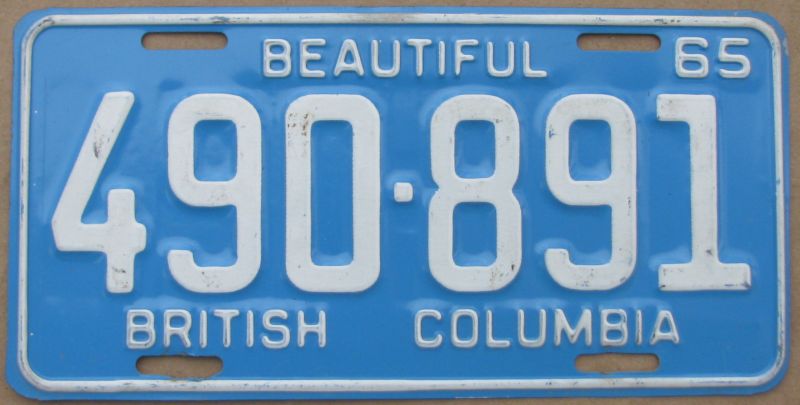 Qualicum Beach issue |
 |
 Qualicum Beach issue |
 |
 |
 |
 Another from out family vehicle |
 Couldn't resist obtaining this upside down of 896! |
 Victoria issue |
 |
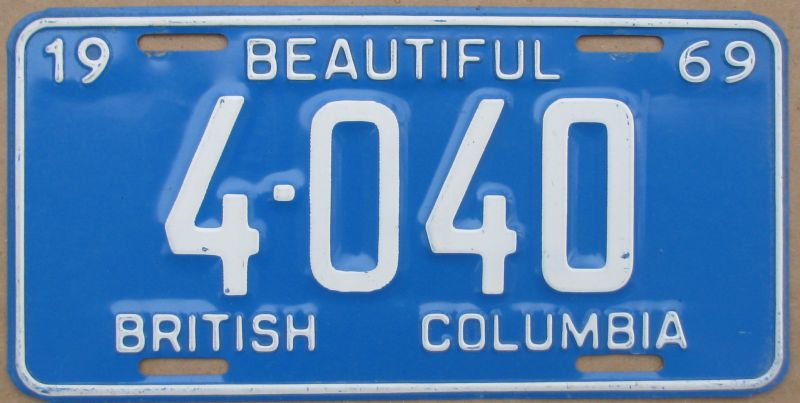 Victoria issue |
 |
|
END OF ANNUAL BASE
PLATES AND NUMERIC
PASSENGER PLATES IN BRITISH COLUMBIA Commencing with the 1970 issue, British Columbia began issuing multi-year plates revalidated with a sticker. This also marked a change from numerical serials for passenger plates to an AAA123 format. I do not plan to go into the complicated issuance of the three letter sequences, but let me just say that it did not simply start at AAA and go to ZZZ. It has been much more complicated than that, and I advise you to do some research if you are interested. |
|

1970 Base |
 1973 Base. Vancouver issue |
|
END OF THE OAKALLA PRISON ERA OF LICENCE PLATE MANUFACTURE (1931 to 1977) By 1977 prison reform in BC made the continued manufacture of plates at Oakalla prison impractical, and from the 1978 run onwards the production of plates has been tendered and carried out by commercial firms. I have included a couple of plates below, from beyond the Oakalla era, but I have no ambition to build a complete run of these. |
|
 1979 Base |
 1985 Base This base has continued to be used to the present, with some variations. In 2001 the serial order was reversed from AAA123 to 123AAA. In 2015 this serial type was superseded by more complex serials with letters and numbers interspersed. |
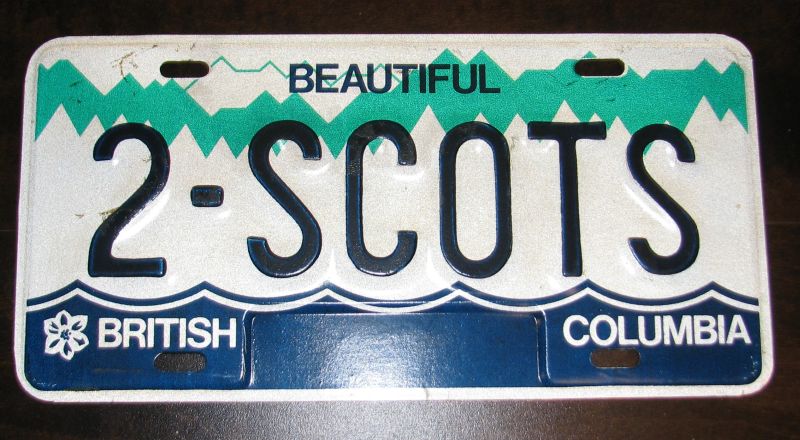 In December 1979 personalized ("vanity") plates were introduced in British Columbia. Dad was one of the early partakers of this modern phenomenon, He and my mother were the two Scots, and they had this plate on their vehicles for the remainder of their driving lives. This example is from the back of the car. The front one shows many years of weathering. |
|



End of British Columbia Page